













Honeybees are disappearing. Nature is being systematically stripped, repackaged, and sold back to us. People exploit land, labor, and one another with increasing “efficiency”. These are just some of the questions that have clearly haunted Yorgos Lanthimos recently. With Bugonia, he doesn’t offer answers so much as force the audience to sit inside the discomfort of asking them. It confronts ecological collapse, corporate power, and human delusion in a language that is unmistakably his. Reportedly, following this film, Lanthimos is stepping away from cinema for a bit to return to photography in his native Greece – making Bugonia feel not just like another provocation, but a pause, a reckoning, and perhaps a quiet exhale after two decades of controlled chaos.
Bugonia is a dark comedy with bite and sting, starring Emma Stone as Michelle, a high-powered CEO of a fictional company. She lives in a glass house, works in a glass office, and adheres to a near-fanatical wellness and Krav Maga routine – all while claiming, with the unabashed confidence of someone who truly believes it, “I’m just a fucking winner.” Jesse Plemons plays Teddy, a sharp-witted, morally (over)driven office worker, while Aidan Delby, a first-time, neurodivergent actor, brings a chaotic energy filled with naivety as Don, Teddy’s cousin and partner in crime. Together, these two conspirators decide Michelle is an alien on a mission to destroy the planet. Their plan: kidnap her and expose her true nature, forcing her to take them to the mother ship.

The first twenty minutes of the film are a stylistic feast, and occasionally a stomach-churning one. Lanthimos leans heavily into tracking shots, distorted angles, and wide lenses reminiscent – his usual style. Also, the colors and some aesthetic choices will remind you of classic ’80s Italian giallo horror, combined with a clear plot nod to Michael Haneke’s Funny Games – two weirdos trespassing, torturing their victim(s) wanting to tear down – or in this case: save – mankind.
Michelle’s pristine glass office, cool Forbes covers and ritualized routine contrast sharply with the cousin’s shabby home, junkfood-fueled diet and low-paying factory jobs. As the story unfolds, Teddy and Don’s morally complicated motivations surface. Teddy’s hunger for justice and personal redemption clashes with his participation in what looks, on the surface, like pure madness. His family’s tragic entanglement with Michelle’s company and its medical experiments subtly layers the narrative with questions of systemic abuse and generational trauma. Meanwhile, Don’s antics, boosted by Delby’s raw, unpolished performance, provide some absurdist relief. Stone’s Michelle is simultaneously terrifying and sympathetic, you’re never quite sure whether she’s a literal alien, a metaphorical “virus”, or simply the human embodiment of corporate ruthlessness. The film’s moral compass is as slippery as its visuals.

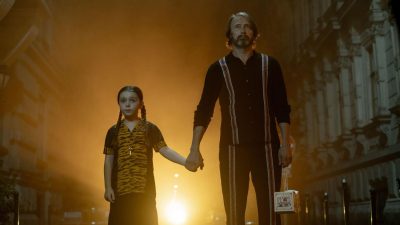
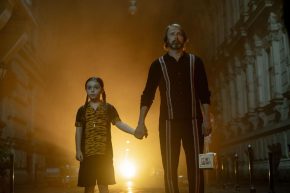
Jesse Plemons stars as Teddy Gatz in director Yorgos Lanthimos’ BUGONIA, a Focus Features release.
Credit: Courtesy of Focus Features © 2025 All Rights Reserved.
The production design by James Price is exquisite. Almost the entire story unfolds in a constructed house with the final sequence shot on a Greek island, providing Lanthimos with a controlled yet versatile canvas. The basement, kitchen, and garden are crafted with laser-sharp attention to color and texture: pristine-white cupboards clash with worn, cluttered spaces, creating visual tension that mirrors the ethical and emotional stakes of the plot. The red- and yellow-lit sequences in the basement, for instance, feel like an innovative take on German Expressionism meets – the stairs creak, the angles bend, and the audience is trapped with the characters in an uneasy, theatrical dance.

Composer Jerskin Fendrix, working from a set of keywords rather than the footage itself, you’ve read that correctly, he only got keywords like “basement” and “spaceship” from Lanthimos, delivers a score that amplifies the film’s off-kilter rhythm and emotional pulse. Editor Yorgos Mavropsaridis orchestrates the pacing masterfully, making sure that even the longer, more chamber-play-like sequences maintain tension without descending into monotony. Every aesthetic choice – from the faux-Jennifer Aniston masks used in the kidnapping sequence to the tracking shots in the supermarket – is superbly calibrated to highlight Lanthimos’ trademark blend of absurdist humor and formal precision.

Performance-wise, Jesse Plemons is magnetic – nuanced, physically expressive, and fully present, effortlessly drawing our empathy while also keeping us slightly on edge. Emma Stone is captivating, though her near-constant lisp in the first twenty minutes slightly undermines the authority of her CEO persona. It would be great if with some help (speech training) she could build characters with no lisping, or just with a wider range for levels of articulation. Aidan Delby, a first-time actor, is uneven, but that unevenness works in the film’s favor: the contrast between him and Plemons amplifies the chaotic, unpredictable energy of their conspiracy.
Bugonia is a moral and existential puzzle: who is alien, who is human, and does the distinction even matter anymore? The script, originally Korean and adapted for American sensibilities by Will Tracy (The Menu, Succession episodes), teeters between biting satire and philosophical reflection, occasionally overwhelming with its intellectual density. Lanthimos’ directorial interventions – especially in visual storytelling – rescue these moments, turning potential exposition into cinematic poetry.

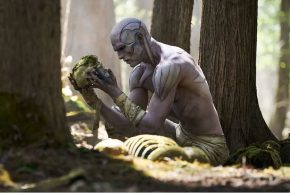
The film’s latter sequences are darkly hilarious and bleakly humane. Scenes that depict characters already dead in a memorable, grotesque moral tableaux, pull the audience into empathy, absurdity, and laughter simultaneously. Bugonia is, in the end, a chamber play wrapped in a dark comedy and a visual manifesto about our reckless stewardship of the world we inhabit.
If there’s a flaw, it is occasionally its over-reliance on dialogue. Naturally, this story demands articulate, philosophical exchanges, however, sometimes leaves subtext underexplored. I would have welcomed more visual storytelling and subtlety, particularly in the film’s morally complex crescendos. Still, this is offset by the strength of the performances, and the never-ending inventiveness of Lanthimos’ direction.
Bugonia is available on Peacock from Christmas onward.
~ by Dora Endre ~





Comments