

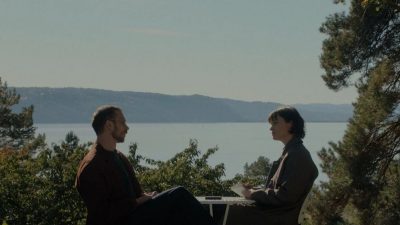











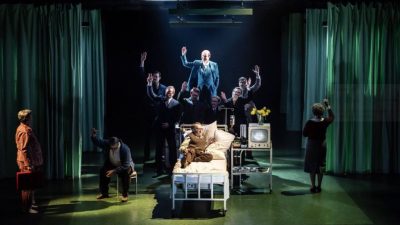



What if a house could feel? Not in a metaphorical Instagram-y way, but truly feel – the laughter bouncing off its walls, the cracks in the floorboards echoing arguments, the joy of dancing shoes crossing its polished wood? Joachim Trier’s Sentimental Value opens with that very question, and it’s a poetic entry into a film that is as emotionally layered as it is visually sophisticated. Shadows are indeed beautiful!
Trier, Norway’s filmmaking wunderkind, whose work has repeatedly balanced sensitivity with formal inventiveness, takes us deep into a family home that is as much a character as the people living in it. From the very first frames – a wide pan across towering cemetery trees leading to a striking fairy tale-like red house – we sense the importance of place, memory, and emotional inheritance. Nora, the elder sister, in an early voiceover, explains that when she was six, she chose to describe herself as the house she lived in.

Sentimental Value centers on two sisters, Agnes and Nora (Inga Ibsdotter Lilleaas and Renate Reinsve), whose lives diverge in ways that feel both ordinary and seismic. Nora, an actress grappling with panic attacks before performances, struggles to reconcile her mental health and creative ambitions. Agnes, younger and more settled, raises a son and navigates the rhythms of family life with the quiet endurance of someone who has learned to find happiness in stability, and frequently investigates her ancestry in archives. Their father, Gustav Borg (Stellan Skarsgård), is a filmmaker of complex interiority – distant yet compellingly charismatic, communicating affection and artistic obsession mostly through his work rather than words or actions, while also struggling with addiction. The plot unfolds when the Borgs gather following the mother’s passing – and the absentee father returns (sneaks into their home, essentially).

The plot unfolds when the Borgs gather following their mother’s passing – and the absentee father returns, quite literally sneaking back into the family home. It soon becomes clear that Gustav hasn’t come empty-handed. He has a film in development and repeatedly nudges Nora to “just have a coffee,” a seemingly innocent invitation that turns out to be a soft ambush: a script, a lead role, and the unspoken hope that collaboration might stand in for reconciliation. Nora refuses outright, without reading a page – “we can’t even talk,” she says – and with that, the possibility of closeness collapses into further distance. Gustav, deeply wounded, later meets the young star Rachel Kemp (Elle Fanning) at a festival screening, striking up an unexpectedly sweet connection. Rachel becomes his new lead, funding falls into place, and the fracture within the family deepens. The final, exquisitely ill-judged twist? Gustav plans to shoot the film in the family home itself.

For anyone who has ever felt the weight of family history, Trier’s film resonates. Wars and political upheavals ripple subtly through the narrative, revealing their imprint on both ancestors and descendants. Flashbacks show a grandmother tortured for “engaging in anti-Nazi propaganda”, while the sisters’ present-day struggles – career pressures, mental health challenges, and intimate relational dynamics – reflect the complex echo of history. It’s a story about how trauma, love, and memory intertwine across generations, and Trier’s hyper sensitive direction makes sure these threads never feel heavy-handed. If anything, it is all lace-like and soft.
Visually, the film is a masterclass. The cinematography by Kasper Tuxed and editing by Olivier Bugge Coutté – Trier’s frequent collaborators – blend homage and originality. Some shots evoke Tarkovsky, others Visconti or Fellini, yet the film remains distinctly Norwegian in its atmosphere. We move seamlessly between static, contemplative frames and handheld intimacy, between tableaux and fleeting, lived-in, documentary-esque moments.

And yes, there’s lots of humor. The film, while steeped in emotion, never takes itself dauntingly seriously. A particularly memorable joke – about a cheap IKEA stool – is guaranteed to make everyone roll on the floor with laughter in the theater, an example for great punctuation amidst heavier themes. Gustav’s birthday gift to his eight-year-old grandson: Haneke’s The Piano Teacher on DVD, is another darkly funny, comedic delight. These moments provide levity without undercutting the emotional weight of the story, and they speak to Trier’s skill in balancing life’s absurdities with its pain.
Equally compelling is Trier’s collaboration with actors. Having recently interviewed him through Sundance Collab, I learned he casts based on rapport and shared understanding rather than rigid script adherence. Stellan Skarsgård, whom Trier calls “Mr. Cinema,” inhabits Gustav with an effortless blend of authority, vulnerability, pain and subtle humor. Admittedly, the character was heavily influenced by the complicated character of Swedish master filmmaker, Ingmar Bergman. The sisters’ performances are equally strong, conveying internalized conflicts, unconditional love and fleeting joys with a rare honesty.
The screenplay, co-written with long-time collaborator Eskil Vogt, is deeply character-driven. The dialogue is precise without being verbose, emotionally resonant without tipping into melodrama. While the ending leans toward sentimentality – not surprising given the title – the film’s thematic richness, exploring identity, grief, generational trauma, artistry, and the search for belonging, far outweighs any occasional maple syrup-level sweetness.
One of the most compelling aspects of Sentimental Value is its meditation on home and personal legacy. The house, a recurring motif, is a silent witness to the ebbs and flows of life, memory, and art. It reminds us that our environments shape us as much as we shape them, and that understanding our past can illuminate both who we are and who we hope to become. Trier’s film is ultimately a gentle yet piercing reflection on connection, creativity, and the ways in which we carry – and sometimes heal – the stories of those who came before us.
For audiences seeking a deeply human, emotionally nuanced story, this film delivers.
Sentimental Value is now playing at theaters worldwide.
~ by Dora Endre ~






Comments