









Some disasters arrive quietly. Others announce themselves with wind, sparks, and a sense of dread that creeps in before anyone could even notice what is coming. The Lost Bus, directed by Paul Greengrass, belongs firmly to the second category. From its opening moments, the film makes it painfully clear: there are no more casual “bush fires” around the corner. This is about a world tipping completely out of balance with nature – and the people who find themselves in its direct path.
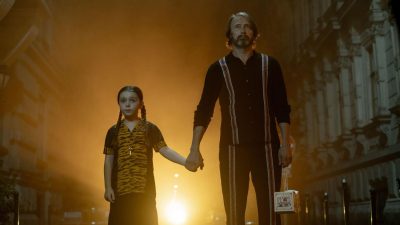
Released this past September, The Lost Bus is based on real events from November 2018, when the Camp Fire tore through Paradise, California, becoming the deadliest wildfire in U.S. history and claiming 85 lives. Greengrass does not attempt a biopic, nor does he package trauma into neat arcs. Instead, he builds a large-scale, classic disaster movie rooted in human endurance, collective responsibility, and quiet heroism. The story follows Kevin McKay (Matthew McConaughey), a newly hired, troubled school bus driver, and Mary Ludwig (America Ferrera), a dedicated schoolteacher, as they fight to save 22 children while navigating an inferno that feels both apocalyptic and alarmingly familiar.

McConaughey plays Kevin with unpolished honesty and charisma that suits the role. The Oscar-winner’s transformation over the past decade – from rom-com boy to an all-around performer increasingly drawn to introspective, riskier material – feels complete here. Kevin is introduced not as a hero but as a man in free fall: his marriage has collapsed, his teenage son resents him, his mother is losing touch with reality, and even his dog is dying. The bus-driving job is temporary, almost accidental, and Kevin himself feels just as provisional. Some of this backstory is spelled out too clearly, and is definitely filled with clichés. The screenplay, written by Brad Ingelsby (Mare of Easttown), often sacrifices subtext in favor of explanation, trusting dialogue where performance alone would suffice. The early scenes are the film’s weakest stretch. But once the fire creeps into the frame, those narrative seams are somewhat burned away.
America Ferrera’s Mary is the bus driver’s emotional counterweight. Grounded, steady, and deeply humane, she brings restraint to a role that could have easily slipped into melodrama – as she frequently says “we just follow the rules, and it is all going to be fine”, right? Ferrera and McConaughey share a compelling chemistry rooted not in on-screen romance but in shared responsibility. Their greatest challenge is not only navigating the physical danger, but maintaining calm for the children while quietly fearing for their own families. The children remain largely anonymous, a choice that is unfortunately very limiting. Only one or two “has a name” and a flat background story.

Greengrass treats the fire itself as a character. Flames advance with purpose, wind becomes a warning system, and danger is often heard before it is seen. Sound design does much of the storytelling here, with crackling embers and rushing air creating a near-physical sense of threat. Cinematographer Pål Ulvik Rokseth (22 July, The Wave) faces the immense challenge of visual monotony – fire allows little variation beyond red, black, smoke, and darkness – but manages to keep the imagery legible and immersive. Occasional blur and disorientation feel appropriate rather than accidental: when the world is burning, clarity is a luxury.
Greengrass leans heavily into his trademark visual language here: rapid zoom-ins and zoom-outs, relentless handheld camerawork, and a sense of motion that rarely allows the frame to settle. In the film’s weakest first twenty minutes, that approach feels unbalanced. With too few establishing or static shots to anchor us, the constant handheld movement can come across as accidental rather than expressive, at times even disorienting to the point of nausea. Once the story fully enters the fire, however, the visual grammar sharpens and finds its rhythm. The chaos becomes intentional, tension-driven, and distinctly Greengrass. Aerial helicopter and drone shots introduce striking bird’s-eye perspectives, expanding the scale while clarifying geography, and loved the inspired choice to occasionally adopt the fire’s point of view. Super inventive!
The production’s blend of practical and digital fire effects adds weight to every sequence. Knowing that controlled, real flames were used on set lends the film a tactile intensity that CGI alone could not achieve. Archival news footage is woven into the narrative and intentionally left visible through color grading choices, as Greengrass said, a decision that heightens the sense of immediacy. The film never lets you forget that this already happened – and could be on the news at any moment.
Yul Vazquez brings understated strength to Chief Martinez, the emergency coordinator tasked with managing a rapidly unraveling situation – he pretty much singlehandedly saves the first twenty minutes of the film. The chief’s leadership is defined by listening rather than commanding, and one line delivered later on in the film – at a press conference, barely contained – feels like its thesis: Every year the fires get bigger, and there’s more of them. We’re being damn fools, that’s the truth. Ashlie Atkinson is a supporting standout as Ruby Bishop, the bus coordinator balancing efficiency, empathy, and rising panic. Her performance adds warmth and occasional levity without undermining the stakes.

Decider
Where The Lost Bus stumbles is largely on the page. Certain emotional beats are predictable, and the ending leans toward a tidy resolution that reality rarely affords. While the film remains faithful to the core of real events, fidelity does not always require narrative neatness. Still, when the film works, it works powerfully. The act leading to the movie’s climax, is relentless and suffocating, culminating in an extended sequence that unfolds largely without music – a striking and respectful choice. Here, sound, breath, heat, and fear are more than enough. No over dramatization is needed.
James Newton Howard’s score is used sparingly and with intention. When it swells, it does so to mark passage rather than to manipulate emotion, most notably during moments of breakthrough – through fire, through uncertainty, through exhaustion. As poet Robert Frost says The only way out is through, and that is the only option this school bus has.
The Lost Bus is an old-school disaster film with modern urgency. Climate change looms over every frame. This is not spectacle for spectacle’s sake; it is a warning wrapped in human faces. It is also a film that deserved a theatrical run. Watching it on a small screen feels insufficient. If you stream it, turn the volume up. Project it onto a wall. Let it breathe.
The Lost Bus is now playing on Apple TV.
~ by Dora Endre ~




Comments