


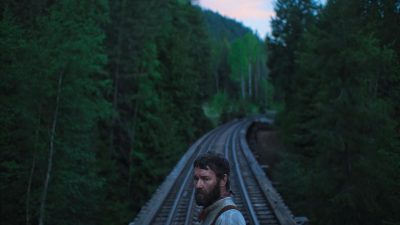














What happens when the image of invincibility cracks? When the public persona of a fighter, sculpted by a gallon of sweat, glory, and bruises, meets the messy, vulnerable reality behind closed doors? The Smashing Machine, Benny Safdie’s first solo directorial and writing effort, asks these questions with uncompromising honesty: and throws them directly into the viewer’s face, in this non-conventional sports drama.
Safdie, whose creative work with his brother Josh put them on the map with raw, kinetic stories like Heaven Knows What (2014), Good Time (2017), and the career-defining Uncut Gems (2019), has always been fascinated by themes of addiction, relationship chaos, and just basic survival. Now, striking out solo, he turns his lens to Mark Kerr, a former amateur wrestler turned MMA fighter, capturing a life that is as physically grueling as it is psychologically layered. The 2025 film premiered at the Venice International Film Festival, where Safdie won Best Director, and since then it has earned Golden Globe nominations, including Best Actor and Best Supporting Actress.

At its core, the movie isn’t about championship belts or victory laps. It’s about Kerr (Dwayne Johnson) as a man balancing immense physical and financial pressures, personal sensitivities, and the fragile, often turbulent love of Dawn Staples (Emily Blunt), his girlfriend and eventual wife. Their relationship serves as the emotional anchor: messy, volatile, yet deeply human. Dawn is funny, troubled, and endlessly resilient, often navigating the precarious line of supporting a high-performing athlete whose life literally hangs in the balance every time he steps into the ring.
The narrative is compelling precisely because it resists conventional sports drama tropes. There’s no clear villain (big rival), no climactic championship bout. Kerr’s battles are largely internal, with the occasional fight in the ring serving as a punctuating note rather than the focus. Early opioid addiction threatens to derail his life and career, and moments like near-overdoses and subsequent rehab highlight both vulnerability and resilience. In this sense, The Smashing Machine feels like an anti-sports biography: it’s less about medals and more about the man behind the muscle, and less about the sport and more about survival and vulnerabilities. What a delicious approach!

Safdie’s direction mirrors this ethos. Shot largely on 16mm with touches of VHS and 70mm, the film evokes a tactile, almost documentary-like realism. Opening sequences completely blur the line between actual footage and cinematic reconstruction, instantly signaling that what we are watching is neither pure fiction nor standard dramatization: it’s intimate, immediate, and raw. Cameraman Maceo Bishop’s work is exceptional: we peek through doorways, leaves, and ring ropes, often through blurred objects, creating a sense of voyeuristic presence, like we’re quietly witnessing moments Kerr might prefer private. Classic Safdie handheld shots and sudden zoom-outs punctuate the chaos without ever feeling gratuitous, particularly in fight sequences, which are dynamic but never exploitative or too graphic.
The editing, handled by Safdie himself, reinforced the film’s rhythm and emotional punch. It is tightly and masterfully cut. Nala Sinephro’s music, while subtle, underscores tension without tipping into melodrama. Non-original tracks are mostly tasteful, though the use of Elvis Presley’s “My Way” cover during the Rocky-esque training sequences feels slightly heavy-handed and, well, unnecessary.

Performances are the backbone of this film, without a doubt. Emily Blunt is nothing short of spectacular, inhabiting Dawn Staples with humor, vulnerability, and a toughness that balances Kerr’s physicality with emotional depth. Johnson, in one of the most surprising turns of his career, delivers a nuanced, deeply empathetic performance. The prosthetic work by Kazu Hiro, which transforms him into Kerr, is meticulous, yet it never overshadows the acting. Johnson’s physical presence is undeniable, but it’s his subtleties – the way he reacts, listens, and vulnerably exposes Kerr’s humanity – that elevate the role. Together, Johnson and Blunt create a believable, troubled, and ultimately compelling duo. And their dramatic scenes are just fireworks.
The behind-closed-doors dynamics are particularly striking in scenes filmed in Kerr’s “home”. Improvised dialogue and inbuilt wall cameras capture intimate arguments and shared moments with an unpolished honesty rarely seen in conventional biopics. Not to mention, these scenes greatly benefit from the long-lasting friendships between the two leads off-camera.
If the film has weaknesses, they reside mainly in the script. Certain sequences feel elongated or veer into familiar sports clichés, especially the second half with the training montages and ring preparation. A stronger narrative climax could have emerged from the raw, high-tension domestic arguments rather than the more conventional fight preparations. Yet these moments are minor quibbles in an otherwise bold, unconventional work that prioritizes authenticity over formula.

Ultimately, The Smashing Machine is a remarkable debut solo effort from Benny Safdie. It challenges typical sports biographies by centering on vulnerability over triumph, relationships over spectacle, and personal truth over dramatic embellishment. It’s a portrait of a man whose public persona of invincibility masks an intricate, often painful humanity. Beyond fights and accolades, Kerr’s greatest victories may well lie in his survival, recovery, and the life he builds alongside Dawn. And I could not help but love the shower sequence where he realizes it.
For viewers interested in the work of a filmmaker who chose a direction that serves his story best – instead of calculating with box office preferences – or sports dramas that break the mold, The Smashing Machine is worth your time.
The film is currently available to watch on Apple TV and Amazon for rental.
~ by Dora Endre ~







Comments