












Ever felt like your life is balancing on a tightrope over a pit of chaos while everyone else is casually walking on solid ground? Welcome to A24’s If I Had Legs I’d Kick You, the darkly funny, intensely human, sometimes harrowing new film from Mary Bronstein. A psychological drama, thriller, and dark comedy rolled into one, it’s a film about the terrifying, exhausting, relentless adventure that is modern motherhood – especially when your child is seriously ill, your spouse is MIA, your home is pretty much ruined and your own body and mind feel like they’re about to snap.
Bronstein draws on deeply personal experiences here. When her daughter was seven, she spent months in San Diego trying to get her treated, living in a hotel room, navigating the labyrinth of medical bureaucracy while her husband, Ronald Bronstein, worked with the Safdie brothers’ on Good Time in New York. The stress, isolation, and creeping sense of collapse Bronstein endured form the emotional core of the film. And that raw immediacy is felt in every frame.

The Story (and the Hole in the Roof)
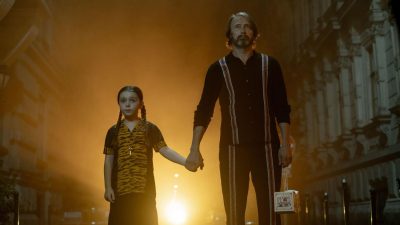
Linda, a Long Island psychologist played by Rose Byrne, is the center of the storm. Her daughter’s mysterious illness demands constant attention, her husband is at sea and communicates with her by shouting over the phone, and her patients range from the tragic to the absurd – often simultaneously. One morning, an accident leaves a gaping hole in her apartment roof, forcing the family into a shabby hotel room. It’s both literal and metaphorical: Linda’s life is falling apart above her head, while she struggles to keep everything else from collapsing. Could she possibly succeed?
As the story unfolds, the film alternates between gut-wrenching reality and surreal, often allegorical visions. Linda is seriously fatigued, drinks and takes drugs so she hallucinates, dreams, and obsesses – her daughter’s feeding tube becomes a symbol of her anxiety, fading into her apartment’s gaping roof. Stars appear in her visions, strange moments of beauty and absurdity punctuating the chaos. It’s Bronstein’s way of making the internal external, and it works brilliantly.

Linda’s interactions with James, the hotel receptionist played by ASAP Rocky, initially offer her a glimmer of connection – but even there, her exhaustion, anxieties and paranoia make genuine trust impossible. She is so consumed by the care of her daughter, the demands of work, and her own crumbling identity and mental health that she cannot even befriend herself. This is anxiety as architecture: each layer reinforcing the other, tilting her toward collapse.
Performance as Survival
Rose Byrne delivers a performance that deserves every accolade it has already received, including a Golden Globe. The camera stays unforgivingly close to her, tracking every microexpression of fear, guilt, hope, love and fatigue. It’s a high-wire act: her face alone carries the weight of the story. There’s no escape for the audience, there is no turning away, which is exactly the point.
Supporting performances are equally compelling. Danielle Macdonald as Caroline, a patient struggling to navigate her own neurotic anxieties, is a quietly potent presence, the chemistry with Byrne feels lived-in and unscripted. Mary Bronstein herself appears as Dr. Spring, the physician treating Linda’s daughter, delivering nuanced and powerful confrontational scenes. Conan O’Brien’s casting as Linda’s psychologist-platonic love interest is more questionable – it’s his first dramatic turn, and the awkwardness shows – but it doesn’t detract from the film’s core. And I truly adore Conan O’Brien – as a comedian.

Motherhood, Isolation, and Societal Blind Spots
Bronstein’s direction is intimate and precise. Her skill lies in the rhythm of the film. Scenes pulse with anxiety and release, moments of absurd humor are threaded through sheer dread. It’s a movie that makes you laugh and then instantly wince, and then marvel at the endurance of a mother who refuses to collapse even when everything around her is shaking and crumbling.
The story is about far more than personal struggle. It’s a commentary on the precariousness of caregiving in modern society. Single mothers, parents of special-needs children, and caregivers everywhere will recognize the impossible standards, the invisible labor, the exhaustion. And Bronstein doesn’t just ask us to witness Linda’s plight – she asks us to feel it, uncomfortably, urgently.

There’s also a critique here of societal and systemic neglect. Governments all over the globe are cutting back social services, health care is fragmented, and NGOs are overwhelmed. The film reminds us that the “superhero” mothers and caregivers who hold everything together in these circumstances rarely get recognition – and the toll is enormous. They need to be seen, heard and helped.
If I Had Legs I’d Kick You is available now on Amazon Prime, Apple TV, and Vudu.
~ by Dora Endre ~




Comments