





There is a special kind of panic that comes with realizing you are suddenly replaceable. One day you are indispensable, the one who brings in cookies and knows everyone’s favorite color at the office; the next, you are an Excel file someone forgot to save. In No Other Choice, Park Chan-wook takes that anxiety and stretches it to its most absurd, violent, and disturbingly plausible extreme. What if surviving the modern job market didn’t just mean networking harder and subscribing to LinkedIn premium – but eliminating the competition?

Premiering at the Venice Film Festival and quietly released around Christmas before earning an extended theatrical run thanks to strong buzz, No Other Choice is many things at once: a dark comedy, a psychological thriller, a crime film, a serial killer story, and a sharp social satire. It is also a remake of Costa-Gavras’s earlier adaptation of Donald E. Westlake’s novel, now reimagined through Park Chan-wook’s meticulous, baroque lens. The result is ambitious, often gripping – and occasionally at odds with itself.

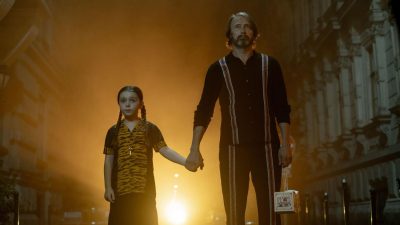
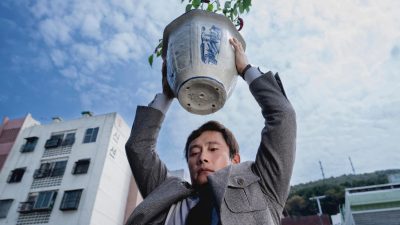
The premise is deceptively simple. After being laid off from his job at a paper manufacturing company where he has worked for fifteen years, Man-su (played with remarkable restraint and vulnerability by Lee Byung-hun) spirals. At first, he tells himself everything is fine. He has a beautiful home – he repurchased the very house he was born in before his family went bankrupt years earlier – a loving wife, two children, a garden perfect for barbecues and sentimental family group hugs. In the opening scene – beautiful colors, wonderfully composed – he asks his family for a quiet minute together, as if trying to freeze time before it slips away.
Then reality hits. Man-su gets unemployed. And not just unemployed: obsolete.
As months pass and job interviews fail, humiliation sets in. He attends support groups where participants chant affirmations and tap their foreheads in emotional release exercises he clearly does not believe in – poor guy cries while practicing. Eventually, he takes a demeaning retail job. He watches younger, equally qualified candidates flood the market. Eventually, he devises a solution that is both horrifying and darkly logical within the film’s twisted moral universe: if there are fewer competitors, his chances improve. And if there’s none left? Well: that’s victory! So one by one, he begins to eliminate them.

Yes, No Other Choice is violent. And yes, after watching it, you may never look at trees the same way again…
Park Chan-wook, the director behind Oldboy, The Handmaiden, Decision to Leave, and the criminally underappreciated Stoker, is no stranger to blood, obsession, or moral rot. He has often been dubbed the “Asian Tarantino,” though the comparison only goes so far. Where Tarantino revels in pop bravado, Park is more interested in intimacy: charged relationships, emotional power plays, and the erotic tension of proximity, whether between lovers, enemies, or family members.

That is why I think No Other Choice feels, at times, like foreign territory for him. This is a larger-scale, more overtly political story, and knowing that the film is dedicated to Costa-Gavras – a living legend of political thrillers – suddenly makes everything click. Park approaches the material with enormous craft and respect, but the fit isn’t always seamless.
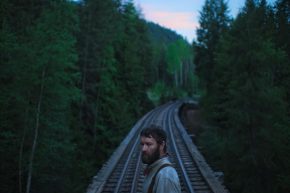
Tonally, the film oscillates between bleak absurdity and genuine menace. There are moments of laugh-out-loud dark comedy: most memorably a three-character showdown in a rival’s home, where guns are drawn, alliances shift, and everyone seems to be attacking everyone else for different reasons. The violence is sudden, messy, and sometimes grimly funny. A snake attack in the woods. A brutal climb up a hill that ends face-first in the dirt. Park still knows how to stage chaos.

Visually, the film is immaculate. Production designer Ryu Seong-hie creates interiors that are stunningly composed, particularly the family home, which feels both aspirational and fragile. Cinematographer Kim Woo-hyung delivers striking lighting and carefully framed stillness, even if some of the ultra-smooth tracking shots and floating camera movements feel more like a high-end video game than a lived-in reality. It’s a style choice that may divide viewers.

Where the film struggles most is in its editing and rhythm. Editors keep the story moving, sometimes too aggressively. Scenes often cut away just before they’re allowed to breathe, robbing emotional beats of their full impact. In the first half especially, transitions can feel abrupt or even disorienting: characters exit one space and immediately appear in another, with little visual or emotional continuity. Whether intentional Brechtian alienation or overzealous pacing, it occasionally pulls you out of the experience.
That said, the performances anchor the film beautifully. Lee Byung-hun is outstanding as Man-su, grounding the escalating absurdity in recognizable human desperation. His slow unraveling never feels cartoonish. As his wife Miri, Son Ye-jin delivers a layered, quietly devastating performance – supportive, perceptive, and increasingly aware that something is deeply wrong. The children, too, add unexpected warmth, especially in moments that contrast the growing darkness of Man-su’s actions.

The symbolism is heavy but effective. Paper – organic, tactile, and ancient – becomes a stand-in for human labor itself, slowly being replaced by automation, machines and digital efficiency. Trees, once symbols of life and growth, take on a more sinister role as silent witnesses and beneficiaries of murders. In this world, progress devours its creators.
Despite its flaws, No Other Choice remains compelling because it never loses sight of Man-su’s humanity. This is not a film about a monster suddenly appearing; it’s about a man slowly convinced that he has no alternatives left, but to become a monster. In an era of shrinking job security, AI displacement, and ruthless competition, that idea lands uncomfortably close to home.

No Other Choice may not be Park Chan-wook’s most personal or perfectly calibrated work, but it is thoughtful, provocative, and filled with moments of undeniable brilliance.
No Other Choice is currently playing in select cinemas and is also available on Apple TV.
~ by Dora Endre ~




Comments