
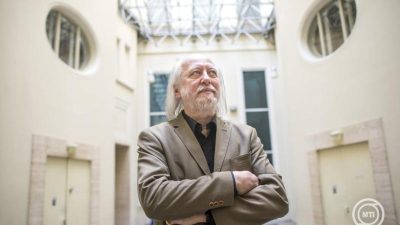

Do you remember the project I-opener from early 2022? In the past four years, lots of things happened for both the brand and the man behind him, founder and arts director Oliver Juan. We asked him about I-opener: Human nature in times of loneliness, which is the newest and so far biggest exhibition, put together after a full year of intense development. From this interview, you can also find out what we kept away from you as a secret last time!
What happened in the last four years?
A lot! The I-opener became an official nonprofit NGO in Berlin, with a whole dedicated team of artists and administrative staff to work on our events. In the last four years, with curator Zuleykha Ibad we have organised various travelling exhibitions, including the one we had in Budapest in 2022. There were nine events in total in Hungary, Georgia, the USA and Germany, bringing arts and sciences together. The most recent is our upcoming exhibition which is going to happen between 13 and 20 December 2025. This one specifically dives in the concept of human nature in times of loneliness, and has common grounds with the previous exhibitions. Partially funded by the German Ministry of Education, it will feature various artworks and a participative video installation that I am directing. Both the NGO and the exhibition are constantly evolving, and we build a lot on our previous experiences.
In 2022, we were discussing the subject of empathy. Why did it shift to loneliness?
I have two answers to this question, a more factual and a more personal one. The first is that nowadays, everyone talks about how technology is used for manipulation and even for a kind of enslavement of people. Many people experience loneliness, and with that, I am not talking about solitude, like when artists need their peace and quiet to create artworks, but something that is out of their control. They want to connect to others but they cannot, for a mixture of societal and individual reasons. They experience FOMO, frustration, fear, failure, just because they struggle (or even refuse) to follow a productivist mindset. We argue that this issue directly links with ecology and the feeling of disconnect from our ecosystem. Some people desire to find a way back and reconnect – be it with their natural environment or other engaged people.
The personal answer is that I have shifted my focus from dynamics in social relationships (empathy) to dynamics in the relationship with ourselves (loneliness). I was interested for quite a while now in how we can feel empathy towards other generations of human beings, or animals, and so on. I was looking for underlying paradoxes, such as how empathy is influenced by whether we have the opportunity to directly influence someone else’s life, or how we can empathise with certain living beings, such as a human baby or a panda, then with others, such as the jellyfish. In our six exhibitions in four countries from 2022-2025, this materialised in a series of social experiments which modelled passing human generations in every screening.

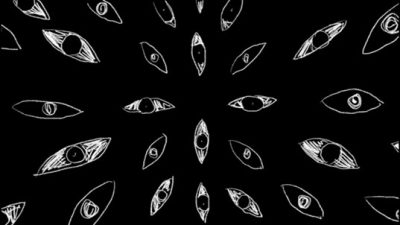
Excerpt from animation of Eva Jiang in the participatory video installation I-opener: Human-Nature in Times of Loneliness (2025).
Now I find myself in complete solitude next the Harz Natural Reserve in East Germany, with not so many younger people around. It allows me to focus on my work but also makes me reflect on my situation a lot. So this has been my big inspiration to tackle this topic.
How much do you think human-human relationships are influenced by the fact that human beings become more and more detached from their natural environment?
I often think about an idea coined by Claude Lévi-Strauss, implying that there is a strong connection between these two developments. The more you cut yourself from organic nature and your “savage” entity to create a life full of artificial elements, the more you cut yourself away from human society as well. It is like splitting a part of us and destroying our wholeness. Of course, this did not happen to all humanity, some societies are more connected to natural cycles and guard their knowledge coming from nature, but that is not typical to our industrialised societies, unfortunately. We sometimes have the illusion that we are not part of nature, but we are; that we are special because of our big brain, but we are not.

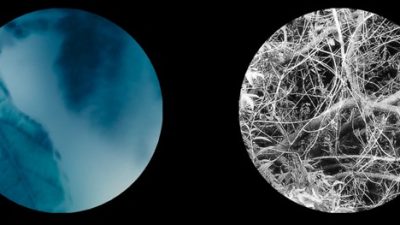
Benjamin Claux – Excerpt from Apocalypse Now? Meteorite scans taken at the CNRS french research centre merge into a speculative landscape questioning how scientific images shape our ecological imagination.
Many people have an anthropocentric view, claiming it is only us humans who can destroy our environment and thereby make our species extinct. Even that is not true, there are also various animals who destroy their environment and thereby their population too. Such examples include the long-tailed macaque in Thailand that cracks shellfish with stones, making the shellfish population drastically drop, and thereby endangering their own survival chances, or the reindeers in Alaska that had a population peak, but it was unsustainable for them and went back to about 50 from 6000 in a matter of a few years. These examples are used in the video installation at the exhibition, too. They are part of a provocative stance that asks human viewers to look at these animals and see ourselves in them. We are not that special and different at all.
How do you use the arts to deliver this message?
In the last interview, I told you not to write down a big spoiler, but now we can mention it. In 2022, we did an interactive video installation in which people were secretly recorded and their emotions captured, and it was then shown to the next “generation” of visitors, whose footage was then shown to the next, and so on. This created a chain, having involved more than 700 people, and still constantly evolving.
A similar concept is applied here, but this time with a different method: less visual and more textual. People will get a test with various quiz questions that they have to answer. The first few questions will be basic: there will be various pictures, for example types of skeletons, or skin, or whatever, and you have to pick the one you consider human. Then it gradually moves towards knowledge on more abstract concepts, such as the golden ratio which has been used among plants as in arts for a long time now. People will realise how difficult it is to answer these binary questions, and this raises the issue of judging others. We judge others on their relationship with Nature so quickly but see our own biases much less.
This science-based, educational, and participative test would be a good way to reflect on this even if it did not have a plot twist. But it has. The tricky thing is that the answers of the previous participants will be under the sheet under calc paper, so they will automatically see it and get under its influence. Maybe they copy someone else’s answer when they do not know it themselves. Or they get frustrated if they see that the previous person gave a factually wrong answer. Once again, this is a metaphor of intergenerational and cultural heritage.
How can such a participatory approach change people’s mindsets?
I think the engagement and participatory experience is a way to get inspired. I can safely say on behalf of all the artists in I-opener that, as artists, we don’t want our audience to passively consume the work; we want them to move, think, respond, and actively make sense of what they experience. How do we expect people to feel? That is a good question. I think the best experience is to see how their attitude changes when confronted with our multimodal arts. This is not mere entertainment but provokes and challenges. This is what the name stands for, too: I am the I in I-opener, and I want to engage, get out of my own bubble, engage with problematic issues, and take action in ecological matters. I expect the audience will have the same feelings when they walk in, or at least when they walk out. They will be personally impacted, touched, and their emotions stirred up.

Clara Juan – Excerpt from Ontologies (2025),
drawing series, animated by Eva Jiang. Symbolic cards illustrating Descola’s four ontologies, inviting viewers to reconsider the cultural lenses through which they interpret the world.
This exhibition is a call. I want to do something about issues in our current society and invite others to join me in this mindset. In the video installation we are trying to compress time and space, and two elements are very important in this regard.
The space element comes from the fact that we are a travelling exhibition. We deliberately choose public and accessible places rather than established art institutions, which creates a mix of people who would not normally meet. The time element comes from the chain of video interactions: each participant leaves something for the next and receives something from those before them, forming a metaphor for generations on earth.
Why is this exhibition specifically happening in East Germany?
This time, I start with a personal answer. I like to discover new places, this is why I have moved around in Europe about twenty times already. Here in East Germany I found a new opportunity recently to be a sustainability manager at a company. I left Berlin for this, which people around me did not really understand. Because, and this is where the factual answer kicks in, East Germany is suffering a lot from extremist ideas lately.
I do not want to judge people for their choices, but it is hard to ignore that the popularity of these ideologies is anchored in a visible feeling of helplessness, frustration, loneliness, and the social structures eroded. This also has a parallel in our perspective on natural resources. During the socialist system, monocultures have been created in this area which were then attacked by invasive species and died out. There are a lot of skeleton forests in this area, which is a strong but sad symbol of of what happens when nature is reduced to a resource. The division between generations is huge, young people are constantly deserting the region, and even I am sometimes scared by it, who deliberately chose to come here. But I also understand those young people who see their future elsewhere. We deliberately keep this exhibition in both German and English to make sure that people in the region with an immigration background, and without perfect German, still have a place where they feel welcome.

Vincent Jondeau – Excerpt from Verschwinden (2025), animated by Eva Jiang.
Filmmaker and visual artist Vincent Jondeau explores ecological memory through photography and archival images that decenter the human gaze.
Your main focal points are technology and ecology. Is this relationship not ambivalent a bit? Technology is often created and distributed in ways that harms ecology…
This is a difficult question, indeed. I think the best compromise is that morality behind technology depends on the user, their motivations, societal structures, and dominant ideologies. We can aim to use it as right as possible. I have to refer to the example of the macaques using tools again; they are a bit like us humans using technology, we can really compare ourselves to them. We cannot possibly say that the macaques are not part of nature, and they use their own “technology” to change their life. That is exactly what we do when we use technologies like fracking, drilling ever deeper in search of oil – a comparison I borrow from French philosopher Gaspard Koenig.
There are still a lot of questions that I do not have easy answers to, however. When you communicate through technology, are you pushing people to use more technology? Do they really want to use more technology at all, or is it societal pressure? What are they using it for? Is it a tool that supports or suppresses more self-reflection? This is symbolised by the last part of our exhibition where our participants see… but maybe let us keep a surprise what exactly.
What can the audience expect from your exhibition apart from what we already discussed above?
Artworks, across different media, most of them never exhibited before. Each of them is closely related to recent scientific research on the Human-Nature relationship, be it from biology, social sciences or history. In our 240 m2 across eight days we’ll present several multimedia installations, a sculpture, prints of drawings, an interactive digital environment.
To complete this, we’ll have a public program, made of five events including workshops and a panel talk. We’re delighted that local organisations wanted to take part, such as UNESCO Geopark Harz who will organise tours on geological formation around the exhibition space.
We’ll also provide educational material and resources to help people engage with local initiatives, designed especially for curious laypersons and younger audiences. It’s an experience for the whole family and an invitation to learn more about ourselves and the world around us.
Follow I-opener on Instagram to stay updated.


Comments