




Some childhood fears never quite leave us. They just change shape. They move from under the bed into the corners of our adult lives, disguised as trauma, grief, or that persistent sense that something is quietly chewing away at the people we love. Dust Bunny, the genre-bending feature debut of Bryan Fuller, leans straight into that idea, then dresses it up as a monster movie, a fairy tale, a crime thriller, and a tender story about survival.
Yes, it’s a lot. And no, it doesn’t always work. But it is never not surprising.
Best known as the creator and writer behind Hannibal, Heroes, and multiple Star Trek episodes, Fuller arrives at his first directorial effort with decades of television experience and an unapologetic love for heightened worlds, stylized violence, and semi-surreal storytelling. Dust Bunny, nominated for Best First Feature at the 2026 Independent Spirit Awards, feels exactly like the film someone like Fuller would make if finally handed the keys: ambitious, strange, visually indulgent, and a little messy.

At the center of the story is Aurora (played with striking presence-cuteness by Sophie Sloan), an eight-year-old girl who believes a violent monster, the titular Dust Bunny, lives beneath the floor of her bedroom. It comes out at night. It eats people she loves. Terrified and desperate, Aurora makes a wish for someone who could kill it.
Be careful what you wish for. Across the hallway lives a man we never learn the name of, played by Mads Mikkelsen with his signature blend of menace, foisted turbulence and deadpan charm. Recently moved in, socially awkward, and clearly criminal-adjacent, he is not exactly the hero Aurora had in mind. but from her childlike perspective, he might as well be one. After secretly following him through the night to Chinatown and witnessing him kill what she perceives as a monster (a splendid, colorful sequence involving a classic Chinese Dragon Dance), Aurora becomes convinced: this is the man who can save her.

Mads Mikkelsen and Bryan Fuller
When her parents mysteriously disappear – leaving only a gigantic pile of feathers behind – Aurora turns to her unsettling neighbor for help. What follows is a reluctant partnership between a traumatized child and a grumpy adult criminal, bonded by fear, violence, and an unspoken understanding that monsters come in many forms.
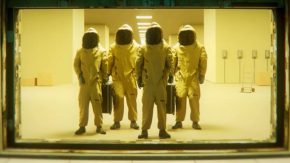
Tonally, Dust Bunny lives in a strange, nostalgic limbo. The opening stretches evoke those eerie live-action fairy tales of the 1980s – European, uncanny, and slightly off-kilter – while the visual language flirts with Wes Anderson-like symmetry, slow push-ins, and carefully choreographed camera movements. The production design is lush and colorful, almost storybook-like, while the sound design leans aggressively into horror territory: creaks, roars, and sonic jolts that feel engineered to unsettle.
Shot largely in Hungary (standing in convincingly for New York), the film makes excellent use of lighting, CGI and color. Teal, orange, and sickly greens dominate the frame, creating a heightened thriller atmosphere that never quite lets you relax. The action sequences are impressively choreographed, and Fuller clearly knows how to stage spectacle, even when working within indie constraints.

But make no mistake: this is not a children’s film. About halfway through, Dust Bunny gleefully crosses a line. There’s a scene involving a dead hitman, a bathtub, and a casual explanation of dismemberment delivered to a child that will likely make parents squirm. The tonal whiplash is intentional, and sometimes effective, but it also exposes the film’s biggest challenge: it wants to be everything at once.
The chemistry between Mikkelsen and Sloan is one of the film’s strongest assets. Their back-and-forth is laced with dry humor, teasing, and an odd tenderness that recalls adventure films of the ’80s and ’90s: stories where precocious children and wounded adults found common ground through chaos. There’s genuine warmth here, and Fuller clearly understands how to direct performance, especially when it comes to rhythm and comedic timing.

Thematically, Dust Bunny is a story about difficult emotions, inner monsters, and the uneasy process of taming – or at least acknowledging – the darkness we carry. Fuller’s metaphors are not subtle, but they are sincere. The Dust Bunny itself, a massive CGI creation, is both grotesque and oddly beautiful, embodying the idea that fear can be terrifying without being purely evil. (Of course, as we all know Nolan would have built the Dust Bunny from wires and wood…)
There are also welcome surprises along the way – most notably Sigourney Weaver in a role that adds a late-film twist without tipping into parody. Her presence feels deliberate, grounded, and refreshingly restrained. And her shoes! No spoilers here. But where can I get them?

Still, ambition can only carry a film so far. Where Dust Bunny stumbles is in its script. The world-building is imaginative, but the character development feels thin, and the narrative runs out of new ideas sooner than it should. Around the midpoint, the film starts circling familiar emotional beats without deepening them. The symbolism becomes clear, the trajectory predictable, and the momentum uneven, despite an ongoing barrage of action, hitmen, and law enforcement chaos.
At 96 minutes, the film paradoxically feels both too long and not fleshed out enough. One senses that with a few sharper character arcs and a tighter script, Dust Bunny could have hit much harder. Instead, it coasts on atmosphere and goodwill, buoyed by strong performances and jawdropping visuals.
That said, there is something undeniably refreshing about Fuller’s willingness to take risks. In a cinematic landscape often allergic to originality, Dust Bunny is unapologetically and in the best sense of the word: weird. It doesn’t smooth its edges or sand down its tonal clashes. It believes, sometimes stubbornly, in its own strange logic.

And that counts for something.
Dust Bunny may not fully deliver on its promise, but it announces Bryan Fuller as a filmmaker worth watching. It’s a bold, idiosyncratic debut, one that wears its influences proudly, stumbles in places, but never loses sight of the emotional core beneath the chaos. A messy fairy tale for adults who remember what it felt like to be afraid of the dark – and are still figuring out how to cope with it.
Dust Bunny is currently playing in select cinemas and is available to rent or buy on Prime Video and Apple TV.
~ by Dora Endre ~



Comments