






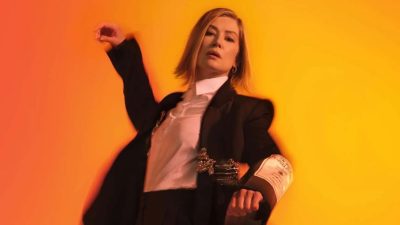



Grief, deadpan humor, Edward Hopper blues – and a literature student who refuses to perform her pain for anyone. Sorry, Baby, Eva Victor’s debut feature, does not enter the room politely. It slides in sideways, quietly funny, a little bruised, and far more daring than its modest indie label suggests. Part dark comedy, part psychological drama, the film feels like a diary you accidentally opened: intimate, heartwarmingly awkward, and disarmingly honest.
Agnes (played by Victor) lives in the aftershock of a traumatic college experience while the rest of the world keeps moving at full speed. Upstate New York looks frozen in time: pale winter light, silent streets, a house glowing in the distance. One of the first images – a car slowly pulling up to that lonely home – feels lifted from an Edward Hopper painting. The film lingers there. No rush. Just atmosphere, unease, and a director already confident enough to let stillness do the talking. Great.

Agnes is a literature student whose life quietly fractures after a traumatic experience at college. Her best friend and roommate Lydie (Naomi Ackie, warm, funny, and effortlessly grounding) becomes her emotional lifeline – the person who keeps the air moving when everything else feels stuck. While Agnes stays behind in the same upstate New York house, eventually teaching at the very school that holds her memories, Lydie moves forward. New York City. A steady relationship. A baby. Two lives drifting in different directions, yet never fully disconnecting. Through their friendship, Sorry, Baby approaches trauma and healing not as grand cinematic statements, but as something messier, slower, and deeply human.
The story is structured in chapters and time jumps, a choice that keeps it fresh and gently unpredictable. The narrative is nonlinear, never confusing but smartly demanding from its audience, it’s like flipping back-and-forth through the pages of Agnes’s life, observing the small shifts that ripple outward. Victor’s writing is precise, filled with dark humor and sharp insight. She never oversimplifies trauma or healing, and she avoids the usual toxic-positivity clichés. Instead, the film trusts the audience to sit with discomfort, to notice the ways grief, anger, and fear intermingle with humor, curiosity, and human connection.

Victor herself is magnetic as Agnes. There’s a delicate blend of fragility and intelligence in her performance: a nervous posture, a slight bend in her body, a doe-eyed gaze that both invites and deflects. It’s a portrayal that feels lived-in, not performed. She’s supported wonderfully by Lucas Hedges as Gavin, whose quiet warmth and gentleness provide some of the film’s most tender moments – particularly in a scene in the bathtub that is as simple as it is profound, capturing deepening intimacy without spectacle. John Carroll Lynch and other supporting actors add texture and presence, proving that even minor roles can carry weight when written and cast thoughtfully.
Undoubtedly, the friendship between Agnes and Lydie is at the emotional core of the film. It’s funny, messy, and beautifully loving: reminiscent of the best television friendships. It reminded me of Netflix’s Dead to Me, actually. Through this friendship, the movie asks questions about loyalty, boundaries, and how we hold one another in the wake of tumultuous life experience. It’s a study in companionship as a form of survival.

Visually, Mia Cioffi Henry’s cinematography deserves special mention. The wintery blues and whites, the soft glow of lamplight, the wide shots of the rural setting – all balance the film’s darkness with beauty. Music (Lia Ouyang Rusli) also plays a subtle but crucial role. The score complements the mood, flowing alongside the narrative without ever intruding.
Sorry, Baby is not a movie that solves trauma. It doesn’t offer easy answers or tidy resolutions. Instead, it honors the messiness of healing, the uneven path of grief, and the strange humor that persists even when life feels unbearable. Agnes’s journey is one of learning to inhabit her own experience fully – to transform sorrow into kindness and to carve space for love, connection and support for others.
Beyond the story itself, there’s something remarkable about Victor as a filmmaker. She reportedly shadowed multiple directors, absorbed as much as she could before stepping behind the camera, and naturally: dedication pays off. The result is both confident and compassionate. Her understanding of character, tone, and pacing is rare for a first feature. The film is also a reminder that independent cinema can very much surprise and sustain a voice distinct from mainstream formulas – thank God.

Julia Roberts even gave Victor a shout-out at the 2026 Golden Globes, urging audiences to see the film: a well-deserved endorsement. The Oscar-winning actress stepped on stage to present the Best Picture – Musical or Comedy trophy and delivered one of the night’s sweetest moments, saying: “I lost, a minute ago… me and Eva Victor, who is my hero. Sorry, Baby – if you have not seen it, see it.” The moment understandably left Victor teary-eyed.
I’d say that is excellent advice, so make sure you see Sorry, Baby. Catch it in select theaters or streaming on HBO and Prime Video.
~ by Dora Endre ~





Comments