












Adapting Albert Camus’ 1942 existentialist masterpiece L’Étranger is famously a fool’s errand. As the first piece of Camus’ “Absurd Cycle,” its deeply internal, first-person narrative has broken the spirits of many filmmakers over the decades. Aside from Luchino Visconti’s exciting 1967 attempt starring Marcello Mastroianni, cinema has largely left the text alone. With his 2026 adaptation, The Stranger, Ozon delivers a beautifully shot, black-and-white, socio-politically sharp work that elevates him to the absolute highest tier of current filmmaking.
For me, his latest film solidifies a thrilling mid-career evolution for Ozon. I have never been a fan of his early works like Swimming Pool or 8 Women. Instead, my appreciation for his filmmaking style sparked with 2018’s By the Grace of God, which marked a pivot toward urgent, socially driven humanist stories. The Stranger rides the same wave, trading internal philosophy for a striking, objective outsider’s point of view.
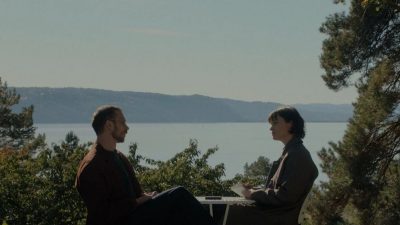
Set in 1930s Algeria, the plot preserves the foundational milestones of the classic novel. We follow Meursault (Benjamin Voisin), a seemingly indifferent Frenchman whose monotonous life is shaken first by the death of his mother, and then by a passionate beach reunion with an old flame, Marie (Rebecca Marder). Rather than drowning the audience in continuous voiceover, Ozon and co-writer Philippe Piazzo use only rare, little glimpses of Meursault’s first-person narration. This creates an artistic distance that forces us, viewers to observe him clinically. Is Meursault a sociopathic walking red flag who tells Marie “love doesn’t mean a thing” when she asks to marry him? Or is he a deeply sensitive soul who simply possesses a different emotional wiring? Voisin plays these ambiguous chords with versatile nuance, and simplicity.

The catalyst for the story’s descent into violence is Meursault’s neighbor, Raymond Sintès (Pierre Lottin), a pimp (what else?!) whose brutal treatment of his Arab girlfriend draws the ire of a local Algerian gang. As racial, financial, and existential tensions collide, Meursault finds himself walking the blindingly hot beach with a gun in his pocket. Ozon brilliantly subverts expectations right from the film’s opening frame. While Camus famously began with “Today, Mommy died,” Ozon completely upends expectations by opening in a courtroom with a line that feels straight out of a Patricia Highsmith psychological thriller:“I killed an Arab.”
By shifting our focus, immediately, to the violent act itself, Ozon injects a sad contemporary relevance into the text. He frames the story around the ignored perspective of the Algerian people, which also greatly challenges the source material. Camus was born and raised in Algeria but pretty much ignored the Arabian’s marginalization in his work. Early on in the film, a vintage propaganda radio broadcast describes Algeria as a sunny extension of Paris where the inhabitants smile in harmony – a piece of colonial propaganda shattered entirely when soon we hear a haunting line “Arab lives don’t matter.” The gasp in the theater when that line was delivered…it was palpable.
The new adaptation is a masterclass in atmosphere too. Due to budget constraints that prevented a full, authentic color palette for a 1930s costume drama, Ozon and frequent cinematographer Manuel Dacosse (By the Grace of God) shot the film in glorious black and white in Morocco – subbing for Algiers. Dacosse captures the sweltering colonial landscape through gorgeous, horizontal static compositions and wide shots. A stunning early close-up / intro frame of Meursault on his bed before tilting up to the window to capture the blinding sun, the literal and metaphorical engine of the upcoming tragedy. Frankly, we should gather data on how many filmmaking constraints, like this, led to legendary results!

I also loved the tumultuous prison cell confrontation between Meursault and a gentle priest (played with the usual, fragile tenderness by Swann Arlaud). It serves as a greatly emotional clash between existential ennui and spiritual salvation. A rare moment, where we see the true face of Meursault: vulnerable, doubtful, and lost.
When it comes to this amazing ensemble cast, it would be hard to find anyone who fell a bit behind. I particularly liked the “delightfully” sadistic turn by Denis Lavant (Holy Motors) as an old neighbor who routinely beats his dog, only to be entirely heartbroken when the animal runs away.
If there is a minor flaw in this otherwise pure piece of cinema, it lies in a slightly over-edited first half. Ozon occasionally relies on too many cuts and unnecessary tracking shots. In a striking early scene where Meursault sits alone in his kitchen smoking a cigarette as a gentle breeze rustles the curtains, the ambient sounds of the Algerian market drift inside. It is a moment so rich you can practically smell the heat, and I found myself wishing Ozon had trusted his actors and left the camera static for much longer. There may be no need for us to see Meursault in his kitchen from e.g. six different angles.

Ultimately, The Stranger works because it behaves like a slow-burn harrowing horror disguised as a romantic drama. It doesn’t offer tidy answers to nihilism, nor does it judge Meursault’s clinical dissociation. It simply asks tons of questions about life, love, identity and much more. Ozon has delivered a mature, deeply relevant triumph that demands to be seen on a massive screen. Purchase your ticket now – and don’t forget to enjoy the Cure track playing over the end credits.
The Stranger is currently playing in theaters, and is also available to rent at home on Prime Video.
~ by Dora Endre ~




Comments