










The pre-premiere screening of Orphan at Puskin Theatre felt almost like a homecoming. The filmmakers were in attendance, the mood was expectant yet gently introspective, and there was that particular buzz that fills a cinema when people know they’re about to witness something personal, and very relatable. After premiering at this year’s Venice Film Festival, the film will officially open in Hungary on October 23, 2025: a date loaded with symbolism, marking the anniversary of the 1956 Revolution. And if you’d like to see something magnificent this year, watch this one on the big screen. Its detail, texture, and sheer visual gravity are meant to be experienced that way.
A Personal History in a Country of Wounds
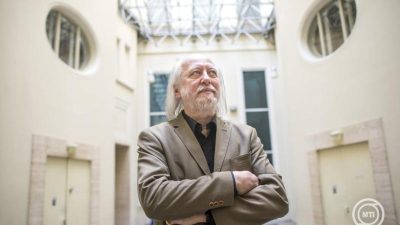
László Nemes doesn’t make easy films. He makes films that linger. His debut, Son of Saul (2015), trapped us within the chaos of Auschwitz through a single, suffocating perspective. Sunset (2018) offered a feverish vision of pre-war Hungary, all mirrors and smoke, a world collapsing under its own illusions. With Orphan, the final part of his informal trilogy on family, history, and trauma, Nemes turns inward, literally. He admits this is his most personal film to date, one that boldly intertwines national memory with his own father’s, fellow filmmaker; András Jeles.
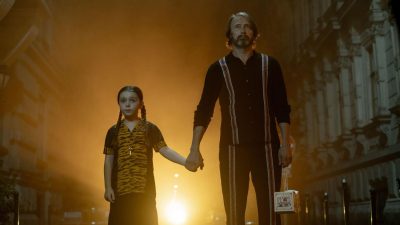
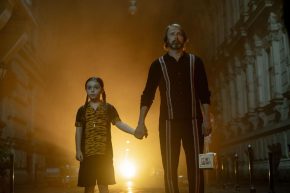
Orphan takes place in 1957, in the still-bleeding aftermath of Hungary’s failed 1956 revolution against the Soviet Army. Budapest is a city of scars, buildings riddled with bullet holes, streets echoing with quiet fear, and a population caught between grief, hope, and survival. Into this fractured world enters a young boy, Andor, raised by his mother with stories of an idealized father lost to the Holocaust. But one day, a frightening man named Berend suddenly appears, claiming to be Andor’s real father. He knows Andor’s mother from somewhere, moves in with an unsettling intimacy, and instantly challenges the boy’s fragile sense of family and identity. Andor, playful yet instinctively defiant, resists this intruder in small rebellions: tossing Berend’s gift of half a pig down from the building’s balcony, standing up to older boys, and testing the boundaries of power in a city still reeling from violence. The story weaves fictionalized drama with historical reality: it’s rooted in the orphaned children of the revolution, the complex layers of trauma Central Europe carries, and deeply personal memories of director László Nemes, whose own family history and scholarly interest in European history bleed through the narrative.

Hungary in the wake of the revolution was a place of loud wounds and loud silences. People learned to live with what couldn’t be said and hide from what seemed to be unbearable to carry. Orphan captures that unspoken heaviness beautifully, the small gestures, the faces that age before they should, the sense of carrying someone else’s pain or absence without quite knowing whose. It’s brave filmmaking, almost therapeutic in its raw awareness. Nemes doesn’t hide behind a bouquet of metaphors; he places his lineage, his family’s survival and losses, right in front of us.
Craft and Cinematic Precision
If Son of Saul was all about claustrophobia and proximity, Orphan moves in the opposite direction. Gone are the subjective, over-the-shoulder shots that became Nemes’s visual trademark. This time, the camera steps back into master shots, watches, and lets the world breathe – sometimes a bit too much.
As always, cinematographer Mátyás Erdély delivers work of astonishing precision and texture. His compositions are a study in restrained beauty, often evoking the meditative, time-stopping quality of Tarkovsky: every frame feels carefully observed, every shadow, pretty reflection and sliver of light carrying emotional weight. There’s a tactile quality to it, you can almost smell the damp air, the city ruins, the fading sandlot. The sets and costumes are immaculate, designed with such authenticity that you feel transported into a time capsule.
Bojtorján Barabás, as Andor, captures the volatile innocence and simmering aggression of a child navigating a treacherous adult world. But it’s Grégory Gadebois as Berend who truly commands attention: whether roaring in on his motorbike or intruding into domestic territory. A true discovery is Elíz Szabó as Sári, a fictionalized friend of Andor. Her brother is on the run after taking part in the blood-soaked events of ’56, and her family is slowly crumbling under the weight of history and antisemitism. The expressive face and eyes of the young actress convey whole stories without a single word.
One of the film’s most endearing spaces is the small grocery store, inspired by the real one where Nemes’s grandmother worked. It’s here that the film feels most alive. The head of the store, the other employees, they’re more than background; they’re part of the texture of survival, part of the history of everyday people who feared for their lives, rose in the ranks or sank abruptly. As we get to know, the head of the store took the place over due to his deep dedication to the Soviet regime.

Yet, for all this brilliance, Orphan sometimes struggles to open up emotionally. The early scenes feel overly intellectual, more concept than connection. We admire what we see, but we don’t quite feel it yet. Nemes’s rigor, his precision, seems to become a wall between viewer and character.
The People Behind the Pain
The cast does admirable work within these carefully constructed frames. Performances are measured, internal, often restrained to the point of stillness. One problem I have with this very present-day Hungarian screen acting is the lack of clear diction – to the point it is less authentic and raw, and more simply: non-comprehensible. Moreover, dialogue tends to be on-the-nose, spelling out what could have been left completely unsaid. People may have had directness in speaking, but a bit of subtext could have been beneficial.
This is surprising given how Son of Saul thrived on silence, subtext and implication. Here, words take over, and not always gracefully. The result is a curious paradox: a film about buried trauma that sometimes refuses to let the unsaid breathe.
Still, there are moments of quiet connection that break through: Andor’s (the lead character / Nemes’ father as a boy) rebellious glance, a hesitation, a tremor in the voice. You can feel Nemes working through his own inheritance, grappling with identity, displacement, and how much of one’s self is shaped by the shadows of others. It’s not flawless, but it’s real. And that makes this a moving and brave film.
By the film’s final act, everything that felt distant begins to coalesce. The narrative gains rhythm and emotional weight. We realize that Andor is a lot like the ’56 revolution: vehement, rebellious and probably destined to fail in its mission. Then comes the last shot: the Ferris wheel.
It’s one of those cinematic endings that doesn’t just tie a film together; it redefines what you’ve just seen. The wheel turns slowly against the fading light, a circle of history and repetition, of lives rising and falling, of (transgenerational) memory that never stops spinning. It’s deeply symbolic, poetic, and quietly devastating.
You realize that Orphan isn’t meant to be cathartic. It’s not about healing neatly or resolving pain. It’s about looking – really looking – at where we come from, and accepting that the past doesn’t disappear. But we can, and we should talk about it.
Nemes has always been a filmmaker of precision and courage. Orphan is an admirable act of vulnerability from a director who could have easily stayed within the international acclaim of Son of Saul’s formula. Instead, he chose to risk it all for something even more personal.
Orphan doesn’t fully blossom the way it could. The script’s emotional restraint and occasional heavy-handed dialogue keep us at a distance. But the craftsmanship, the ambition, and the sheer honesty behind it are undeniable. For anyone who loves cinema that dares to confront rather than comfort, this film is worth your time and your attention.
~ by Dora Endre ~






Comments