




The trouble with hyper-personal filmmaking is that sometimes the material hits a little too close to home. When a director steps behind the camera to unpack their own reality, they face a dangerous choice: strip away all emotional armor, or bury the story under so many protective layers that the cinematic core suffocates. I don’t think there is a middle ground.
Australian director and writer Sophie Hyde, a long-time Sundance sweetheart, clearly wrestles with this problem in her 2025 family drama, Jimpa. The film carries a heavy semi-autobiographical weight – Hyde herself is from Australia, is parent to a non-binary teenager, and had an estranged father who recently passed away. Yet, instead of channeling these raw parallels into a narrative focus, Hyde seemingly puts too much protective distance between herself and the project. The result is a movie overflowing with beautiful, noble intentions that unfortunately expands in so many directions at once that it becomes muddled, fragmented, and at an hour and fifty minutes, quite frankly, often dull.

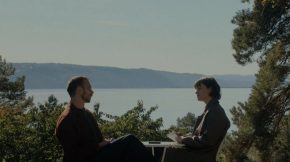
The story follows Hannah (Olivia Colman) and her 16-year-old non-binary teenager, Frances, as they travel to Amsterdam to visit Hannah’s gay grandfather, Jim (John Lithgow), affectionately known as “Jimpa”. The family dynamic is immediately thrown into a tailspin when Frances suddenly announces she wants to stay and live with Jimpa for a year: a punch-in-the-face-challenge to Hannah and her parenting boundaries that forces her to confront a complex web of transgenerational trauma.

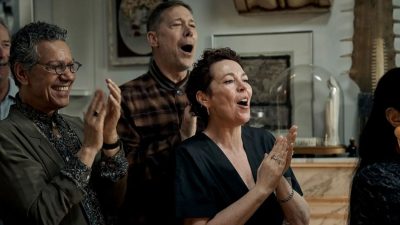
As a filmmaker, Hannah acts as an obvious alter ego for Hyde. Early on, we see her on Zoom calls and reviewing self-tapes for an upcoming movie in development – a project based directly on her own parents’ unconventional marriage. After her father came out as gay, her parents didn’t divorce, instead, they pioneered a polyamorous, open relationship, remaining co-parents and housemates for another decade. But when Jim eventually left for a university professorship in Amsterdam, he refused to let Hannah’s mother and sisters join him on the journey. Hannah has carried these abandoned wounds for years, waiting for the right moment to confront him – only to be blindsided at a party when Jimpa casually announces to his hopeful grandchild that he is abandoning Amsterdam for a new position in Oslo. C’mon, once restless is always restless!

When analyzing Jimpa, one cannot help but draw an immediate association to Joachim Trier’s Sentimental Value. It plays out like the LGBTQ+ version of that exact cinematic universe – sharing a somewhat similarly delicate visual style, an exploration of memory, and a narrative driven by a strange, magnetic, yet deeply flawed patriarch whom a daughter must learn to forgive. Lithgow plays Jimpa with a bold, unapologetic confidence, even baring himself stark naked in multiple scenes with a vulnerability that rivals Stellan Skarsgård’s magnetism. Colman, as expected, is brilliant, stealing every scene she occupies with raw naturalism and emotional depth. She is as sensitive as the finest piece of hand embroidery.
The surrounding cast is equally stellar, particularly Eamon Farren as Richard, Jimpa’s emotionally trampled university assistant. The unspoken, deeply supportive bond between Hannah and Richard stands out as one of the most beautiful elements of the script. It is exactly the kind of deep, unconditional, non-verbal connection you wish the film spent more time exploring. The most wonderful type of rapport we may find in life – if we’re lucky enough to do so.

Unfortunately, the film’s emotional momentum hits a brick wall whenever the spotlight shifts to Frances. Cast with Hyde’s own child, newcomer Aud Mason Hyde, the performance lands incredibly flat. Playing opposite heavyweight titans like Colman and Lithgow is an undeniably brutal task for an untrained actor, but Aud’s scenes consistently drain the tension from the room, rendering Frances’s subplot – which includes a very briefly thrown-in sexual awakening in Amsterdam – the weakest link in the chain.
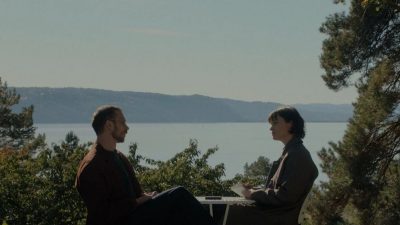
Where Jimpa truly triumphs, however, is in its gorgeous and creative visual grammar. Cinematographer Matthew Chuang – another fast-rising Sundance favorite known for Blue Bayou and Chief of War – uses a distinct, coolly lit indie palette to paint the canals and row houses of Amsterdam. My absolute favorite scene is a lovely bathroom scene where mother and child share a bath. It must have taken a crazy amount of pre-planning! Through a gorgeous, painterly composition and a clever use of mirrors within a tiny space, Chuang and Hyde capture a moment of pure visual poetry.

Furthermore, Hyde introduces a very cool, seamless editorial rhythm using brief, non-verbal snapshots of memory. For instance, when Hannah’s sister abruptly arrives, we are treated to a sudden, joyful flashback of the pair dancing as children in a kitchen. Similarly, whenever we meet the elderly gay community of Amsterdam who surround Jimpa, Hyde weaves in quick, beautiful snapshots of these men in their youth: marching in protests, arriving in the city, and surviving the weight of the 1980s AIDS crisis. It is a visually spectacular way of establishing their rich history without relying on clunky exposition or dialogue. Show don’t tell: bravo!
Ultimately, Jimpa simply tries to be about too many things at once. In its frantic effort to be an educational, woke thesis on modern queer identity, it packs in debates over evolving LGBTQ+ vocabulary between older 1970s activists and Gen Z, discussions on polyamory, global citizenship, aging, stroke recovery, sisterhood and more. By refusing to edit its thematic to-do list, the film fails to carve out its characters fully. Less would have been more. More of the real protagonist, Hannah / Hyde, would have been infinitely more.

Despite its narrative stumble, the movie’s final act possesses a predictable yet sweet and genuinely emotional payoff that makes it worth the ride for the acting alone.
Jimpa is currently available to watch on Prime Video, Hulu, and Apple TV.
~ by Dora Endre ~



Comments