






Inside The Rebellious World of Orson Welles
If you ever find yourself wandering the elegant, chocolate-scented arcades of Turin, look up. Soaring 167 meters into the Piedmontese sky is the Mole Antonelliana – or simply “The Mole,” as the locals affectionately call it. Originally commissioned in 1863 as a synagogue, this majestic monument eventually found its true calling. Today, it houses the Museo Nazionale del Cinema – a sprawling, multi-tiered sanctuary that Martin Scorsese famously dubbed “a real temple of cinema.”
Stepping inside is a profoundly moving experience. The open-concept, vertiginous interior brings to mind the soaring circular geometry of New York’s Guggenheim Museum, but infused with a distinctly cinematic heartbeat.

My visit comes courtesy of a collaboration with the museum, who invited me to ride their legendary glass elevator. Suspended by invisible cables, it shoots directly through the center of the vast open dome – definitely not for the faint-hearted! As you ascend past the open floors, you catch breathtaking glimpses of visitors resting on red beanbag chairs in the grand hall below, watching classic films on giant screens, surrounded by neon-lit installations, surrealist art, and the history of visual storytelling. Once at the very top, you are rewarded with a dizzying 360-degree panorama of Turin framed by the distant, snow-capped Alps.
The Genius, the Rebel, the Provocateur
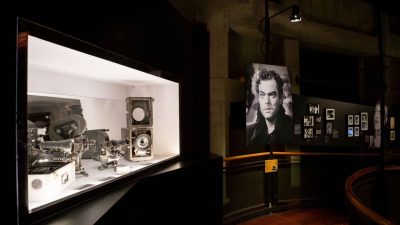
Currently presiding over the museum’s central space is the magnetic exhibition, “My Name is Orson Welles” (running through May 10, 2026). A towering cutout of Welles as Charles Foster Kane stands atop a podium in the main hall, addressing the crowds below with larger-than-life bravado.
The exhibition takes its title from one of Welles’ most deliciously audacious quotes:
“My name is Orson Welles. I am an actor. I am a writer. I am a producer. I am a director. I am a magician. I appear on stage and on the radio. Why are there so many of me and so few of you?”

Welles was an intoxicatingly complex figure – a prodigy, an accomplished painter (a discipline he quietly considered his truest passion), a trained magician, a passionate civil rights advocate, and an unapologetic rebel who refused to bow to Hollywood’s rigid studio system.
The exhibit traces his story right from the beginning, displaying his official 1915 birth certificate from Kenosha, Wisconsin. Tragically losing his pianist mother at a young age in 1924, young Orson was raised amidst Chicago’s high society, caught between competing father figures while coping with family tragedy. In later years, Welles self-deprecatingly described his childhood self to his close friend and collaborator, French screen icon Jeanne Moreau, as a mere “third-rate boy genius.”
By 1926, attending the arts-focused Todd School for Boys, 10-year-old Orson was already staging ambitious Shakespearean plays. Press clippings from the era profile the boy wonder as a “poet, artist, cartoonist, and actor” who had “so many ambitions he cannot decide what he will be when he grows up.”

Conquering the Stage and Shocking the World
Before Hollywood even knew his name, Welles was living life like an adventure novel. At just 16, he lied his way onto the stage at Dublin’s Gate Theatre, instantly transforming into a seasoned professional. What followed was a whirlwind period of romantic wandering: traveling through London, attempting to become a bullfighter in Spain, and writing pulp novels for pocket money.
By 1933, he was conquering New York. Deeply idealistic, Welles held a profound belief in social justice, civil rights, and human equality. In April 1936, at just 20 years old, he stunned the theatrical world by directing the famous “Voodoo Macbeth” in Harlem with an all-Black cast, transplanting Shakespeare’s tragedy to a spellbinding Haitian voodoo setting. French visionary Jean Cocteau was among the spellbound audience members on opening night. Alarmed by the rise of European fascism, Welles followed this with a modern-dress production of Julius Caesar, styling his actors in contemporary fascist “black shirts” – a revolutionary political statement that made international headlines.

Then came 1938. With his legendary Halloween radio broadcast of H.G. Wells’ The War of the Worlds, Welles convinced millions of panicked Americans that Martians were actually invading New Jersey. Overnight, the 23-year-old was the most famous entertainer in America.
The War with Hearst and the Birth of Citizen Kane
Sensational radio success caught the eye of Hollywood. RKO Pictures lured the young prodigy to California with an unprecedented contract: total, unadulterated creative control over his films, including final edit privileges – a deal never seen before or since.
Given complete freedom, the 25-year-old director delivered what many consider the greatest movie ever made: Citizen Kane (1941).

However, the film ignited an all-out war with media mogul William Randolph Hearst. Recognizing thinly veiled parodies of himself and his mistress, actress Marion Davies, Hearst was incandescent with rage. He demanded the studio destroy the film’s negatives, banned any mention of Kane across his massive newspaper empire, and pressured theater chains into boycotting its release. Though Hearst’s stranglehold initially sabotaged the film at the box office, Citizen Kane revolutionized visual storytelling forever.
Studio Heartbreak and Post-War Exile
The political tide soon turned against Welles. His outspoken progressive activism drew the paranoid scrutiny of J. Edgar Hoover’s FBI, the Turin exhibit displays a heavily redacted confidential FBI file from 1944 investigating Welles for alleged “subversive” sympathies.
By 1942, while Welles was in South America on a wartime diplomatic cultural mission, studio executives seized control of his second film, The Magnificent Ambersons, brutally re-cutting it behind his back and adopting the ruthless studio motto: “Showmanship in Place of Genius.”
Exhausted by studio interference, Welles left for European exile in 1947. Over the next decade, he led a nomad’s life, taking high-paying European acting roles to self-finance his own passion projects. Indeed, Welles famously remarked that only 20% of his life was spent on the actual craft of making movies, while 80% was spent on the exhausting hustle to find funding.

In 1949, he starred as the charismatic villain Harry Lime in Carol Reed’s noir masterpiece The Third Man. Welles adored the role, though it carried a touch of amusing bitterness: he often joked that for the rest of his life, he couldn’t step into an elegant European restaurant without the house band immediately breaking into the film’s famous zither theme!
Wandering, Kafka, and more Shakespeare
European locations continued to ignite his architectural imagination. When funding collapsed during production of his 1962 adaptation of Franz Kafka’s The Trial, leaving him with no budget for sets, Welles improvised. He moved the entire shoot into the Gare d’Orsay – then a cold, abandoned Paris train station – finding in its vast iron arches a melancholy sense of waiting that suited Kafka’s claustrophobic nightmare.
Yet, of all his cinematic achievements, his heart belonged to Chimes at Midnight (1965). Adapted from five Shakespeare plays and filmed on a tight budget in Spain, the film cast Welles as Sir John Falstaff, exploring the tender, tragic friendship between the clownish knight and Prince Hal. Welles held the film in sacred regard, once proclaiming: “It’s my favorite picture, yes. If I wanted to get into heaven on the basis of one movie, that’s the one I would offer up.”
Love, Passion, and Private Anchors
While his professional life was played out in intense public storms, Welles’ private life was anchored by fascinating women.
His first marriage was to actress Virginia Nicolson (1934–1939), with whom he had his first daughter, Christopher. Following their separation, he engaged in a high-profile, passionate affair with Mexican film star Dolores del Río – one of the great romantic sagas of 1940s Hollywood.
In 1943, he married Hollywood’s premier “Love Goddess,” Rita Hayworth. Their glamorous, turbulent marriage produced his second daughter, Rebecca. Even after their 1947 divorce, Welles spoke of Hayworth with deep affection, calling her “one of the dearest and sweetest women that ever lived.”
It was his third marriage that provided the steady anchor of his life. In 1955, Welles married Italian aristocrat and actress Paola Mori. Their union endured for 30 years until Welles’ death. Together with their daughter, Beatrice Welles, they formed a tight-knit, private family unit away from the Hollywood glare.
In his later years, Croatian artist and filmmaker Oja Kodar became his creative collaborator and romantic partner. Together, they worked on avant-garde projects, including F for Fake (1973) and the satirical Hollywood meta-film The Other Side of the Wind.
The Creator Who Never Slept
By the 1970s, Welles was back in America, transitioning into a beloved pop-culture icon – appearing on talk shows with Johnny Carson and Merv Griffin, and intoning his famous catchphrase, “We will sell no wine before its time,” in iconic commercials for Paul Masson Vineyards.
Yet behind the media persona was a man who never stopped creating. Friends recalled that Welles lived in a state of perpetual artistic motion, sleeping only a couple of hours around dawn before returning to his typewriter.
His end arrived with suddenness. On the evening of October 9, 1985, Welles recorded a nostalgic interview on The Merv Griffin Show. Returning home to Hollywood, he stayed up late into the night, typing stage directions for an upcoming magic special. On the morning of October 10, he was found slumped over his desk, having suffered a fatal heart attack at age 70 – his hands resting right beside the typewriter that had fueled his imagination until his very last breath.
Looking at his legacy today, one cannot help but imagine how Welles would have thrived in our modern digital landscape. He was, after all, the ultimate independent creator trapped in a mid-century studio system. Today – armed with direct-to-audience platforms, streaming, and smartphone cameras – Welles would have comfortably bypassed traditional Hollywood gatekeepers altogether, broadcasting his unfiltered genius directly to the world.

Rosebud and the Magic of Turin
What makes the exhibition at the Mole Antonelliana so impressive is how tangibly it brings us Welles’ creative spirit. You can examine handwritten script pages with camera notes, personal sketches, and even his earliest screen tests. In the center of the main hall stands a mesmerizing mini-“Rosebud House” – an immersive installation featuring a giant replica of the iconic glass snow globe from Citizen Kane, complete with falling snow and a lonely sled tucked inside.
Beyond the Welles exhibit, the museum itself is a marvel. Dedicated spaces celebrate experimental cinema, designed like a mad scientist’s chemical laboratory, alongside interactive VR experiences and temporary pop-culture exhibits.
A complete journey through the Mole Antonelliana is a true deep-dive – plan to spend roughly 3 to 4 hours taking it all in. Don’t rush. Do as the locals do: when museum fatigue sets in, grab a spot on one of the plush red beanbags in the central hall, look up at the soaring geometric ceiling as the glass elevator glides overhead, and let the sheer, dramatic magic of cinema sweep you away. After all, a little dolce far niente never hurt anyone!
This article was created in collaboration with the Museo Nazionale del Cinema di Torino and Veronica Geraci.
~ by Dora Endre ~



Comments